Category Archives: Financial Crisis

Argentina’s Last Gasp of Deception Before Its Default

In December 2001 the world saw Argentina voluntarily walk away from its debt obligations. In a storm of nationalistic rhetoric the country defaulted on billions of dollars of sovereign debt. The massive default caused the Argentine economy to collapse. The difficult economic times drove more than half of the country’s population below the poverty line. Not surprisingly; international lenders and institutions have been reluctant to again lend money to the country. It must be stated that since the default Argentina has reached agreements with about 90% of the bondholders. The investors have been offered a small percentage of their original investment and had their defaulted bond exchanged for new ones. The country has twice restructured the new debt. Some of these exchange bondholders had to believe that receiving something for their investment was better than receiving nothing. They might be right, but only to a limited extent. 

It did not come as a surprise to the commentators and experts that investors would eventually grow weary and suspicious of Argentina’s constantly restructuring its debt. These restructurings were basically forced upon the exchange bondholders. The restructure terms clearly favored Argentina. In October 2009 Japan’s finance minister criticized the South American country over its debt restructuring scheme(s). He accused Argentina of not negotiating in good faith with it creditors. Has Argentina ever respected the interests of its bondholders?

President Fernandez Resisting

Photo Eduardo Di Baia, AP

About 10% of the original bondholders decided to sue to recover their complete investment(s). In a earlier post I discussed the torturous and never-ending path of the litigation. I also considered the significance of Argentina’s latest appeal in the 10 year legal battle with the 2001 bondholders. I believe that the courts have finally reached their limits with Argentina’s refusal to pay on money judgments while continuing to litigate the same legal arguments over and over. The courts are aware of President Fernandez’ public declarations that Argentina will never pay “vulture funds.”

On February 27, 2013 the U.S. Court of Appeals for the 2nd Circuit (Court) heard oral arguments on Argentina’s latest appeal. The presiding judges made it clear that they were not there to interpret the terms of the bond contracts but to enforce them. The Court dispensed with any notion that Argentina might have had about litigating  de novo the underlying case. The issue before the court centered on the federal court’s imposed repayment scheme. The attorney for the Argentine Republic intimated that his client would be amenable to payment but under a different scheme. This limited and qualified suggestion of a possible settlement of the payment issue intrigued the Court. The judges directed appellant (Argentina) to file its plan for the cancellation of the plaintiffs’ judgments. The order was as follows:

At oral argument on Wednesday, February 27, 2013, counsel for the Republic of Argentina appeared to propose that, in lieu of the ratable payment formula ordered by the district court in its injunction and accompanying opinion of November 21, 2012, Argentina was prepared to abide by a different formula for repaying debt owed on both the original and exchange bonds at issue in this litigation. Because neither the parameters of Argentina’s proposal nor its commitment to abide by it is clear from the record, it is hereby ordered that, on or before March 29, 2013, Argentina submit in writing to the court the precise terms of any alternative payment formula and schedule to which it is prepared to commit.
A New Beginning or End for Detroit?

In 1960 Berry Gordy Jr. founded the record company Motown . The newly incorporate business was based in Detroit, Michigan. The City of Detroit has long been referred to by Americans and the international corporate world as the “motor city.” Motown had been setup in the very same city that America’s auto manufacturing companies had always called their home. I do not believe that it was a coincidence that Berry chose the name Motown, short for motor town, as the name for his new corporation. In the turbulent 60s Motown was instrumental in integrating popular music with a multitude of black artists whose music collectively became known as “soul music.” In 1972 Motown relocated to Los Angles where it remained an independent company until being sold in 1988. Motown’s run in the record industry was not only successful and profitable the company also left an indelible cultural mark on American society. The City of Detroit has not fared as well as its homegrown record company.

On March 1, 2013 Michigan Gov. Rick Snyder strode up to the podium at a called news conference to address Detroit’s fiscal mess. In the audience were members of the press, a handful the city’s political leaders and corporate officials of the beleaguered business sector. There was no suspense as to what the governor would talk about. Detroit was teetering on the brink of municipal bankruptcy. The Michigan governor had decided to take action to prevent a worsening of the city’s financial condition. Gov. Snyder prefaced his remarks by stating that no other city in the United States was a financially challenged as Detroit. He had determined that city’s “woes too fundamental, too lasting and too large to be solved by the city itself.” Much to the disappointment of local politicians the governor announced his intention to appoint an emergency financial manager (EFM) to oversee Detroit’s finances. The EFM would have broad powers to act on behalf of the public. Some of the city’s school districts are already under emergency management. The city faces more than 14bn in long term debt and has had chronic problems with available cash to meet payroll and other daily expenses.

To make matters worst for Detroit residents Forbes magazine designated Detroit as America’s most miserable city. Unemployment, violent crime and home values at historic lows guaranteed the city one of the top spots on the list. The added fact that the Motor City was on the verge of being taken over by a state appointed financial manager and has been

From The Business Insider

From The Business Insider

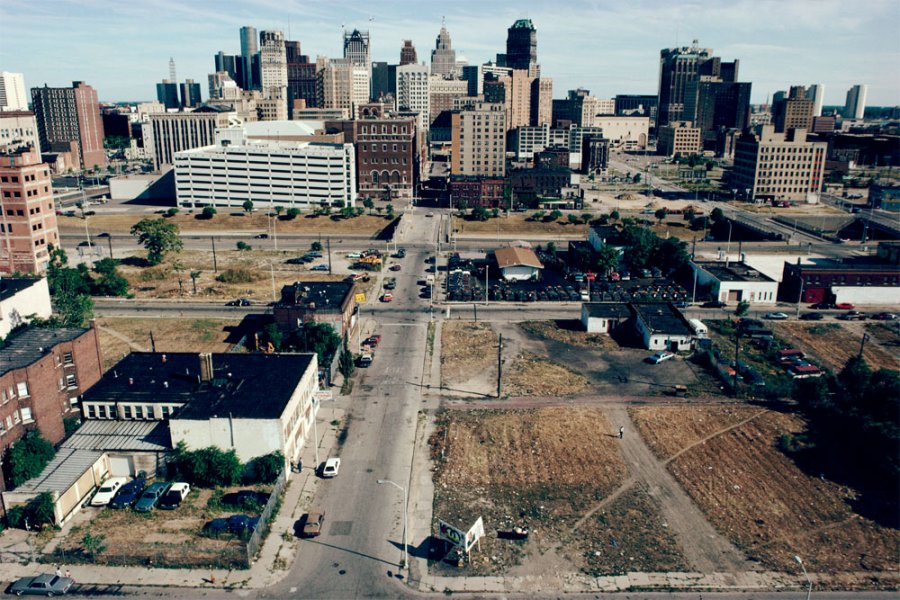
issuing debt to pay its daily expenses propelled the city into the top spot on Forbes’ list. Detroit has researched its statutory limit for issue debt. It cannot raise any more money and this has precipitated the crisis for the Gov. Snyder. In simple terms; Detroit is so broke. Seeing the city’s degree of decline in pictures is stunning.

Three years ago Mayor Bing was elected into office. He promised voters that he would turnaround the city’s finances. Every year since then he has had the support of the City Council. His initiatives have met little opposition. Yet, Mayor Bing who, like the governor is an accomplished businessman, has been unable to rein in Detroit’s runaway fiscal problems. Success as a businessman does not necessarily translate into success as a politician. The economic data does not lie; under Mayor Bing’s tutelage Detroit’s problems have grown and multiplied. The bad economy, cutbacks in state and federal aid and escalating pension and healthcare costs have exasperated the fiscal problems. Regardless of these factors I agree with the commentators and experts who point to Detroit’s city government’s incompetency, corruption and shortsightedness for bringing the city to this fiscal abyss. Politics and not economics seem to Detroit’s problem.