Category Archives: Politics

Mayor de Blasio’s Push for Affirmative Action in the City’s Elite High Schools

New York City Mayor Bill de Blasio makes an education announcement regarding specialized high school at J.H.S. 292 in Brooklyn, New York on Sunday, June 03, 2018.

New York City Mayor Bill de Blasio makes an education announcement regarding specialized high school at J.H.S. 292 in Brooklyn, New York on Sunday, June 03, 2018. CREDIT: Benjamin Kanter/Mayoral Photo Office

On June 3, 2018, New York City Mayor Bill de Blasio and Schools Chancellor, Richard A. Carranza, held a news conference to announce their plan for diversifying the City’s 8 elite high-schools. The officials avoided saying anything that hinted at the establishment of racial quotas or an affirmation action program. The Mayor stressed the fact that these schools’ student populations were only 10%, Black, and Latino. In contrast, Blacks and Latinos (hereinafter referred to as “Minorities”) make up 70% of the student population in the City’s regular schools. The two officials were flanked almost exclusively by ardent Minority supporters of the “diversification initiative.”

I watch the news conference live as it was taking place. When it was over, I concluded that some of it had been staged for a greater political purpose. After years in office, the Mayor was finally delivering on a promise to his Minority supporters, knowing that his decision would cost him political capital that he can ill afford to squander. Having won reelection, which was not difficult, the Mayor believed it was time to put into practice his beliefs about social justice. Regardless of how the Mayor tried to characterize his plan, its implementation would mean that many students who worked hard to gain admission to an elite school would be denied entrance in favor of academically less deserving Minority students. Does anyone dispute this fact?

The Mayor offered a two-pronged plan of action to increase Minority enrollment at the elite high-schools, which are led by Stuyvesant High School :

Diversity Program
In June 2016 then Chancellor Carmen Farina established six new initiatives to provide more outreach, tutoring, and opportunities for underrepresented students to enroll in the City’s elite high schools. The Mayor wants to expand this program and set aside 20% of the seats at these schools to students from high poverty schools.

Stuyvestant High

Photo Courtesy of the WSJ.com

Eliminating the SHSAT Entrance Examination
Admission to the elite schools is based upon achieving a satisfactory score on the Specialized High Schools Admission Test. The Mayor wants to eliminate this test as a requirement for entrance. The Mayor does not have the legal power to eliminate that test. The NYS Legislature must enact a law eliminating the SHSAT. Albany lawmakers over the years have failed to even debate eliminating the examination.  Consequently, it is unlikely that Mayor de Blasio’s request will be granted by Albany lawmakers.

Regardless of its legislative prospects, the diversity was plan was immediately denounced by many groups. The Asian community led the way in speaking out against the Mayor’s proposed plan. Asian students are majorities at all of the elite schools. No one doubts that this is due to their families’ and communities’ pushing them to excel academically. The Asians fully understand that the setting aside of seats for Black and Latino students at the elite schools will necessarily remove from consideration many very qualified Asian students. I do not believe that Mayor da Blasio is prepared to lose the support of Asians and other minorities just to appease families of poorly achieving Minorities.

As a society, it is likely that we have reached the limits on the utility of diversity as its definition becomes unmanageable and more political. The pushback that the Mayor is experiencing from the Asian community is a result of this reality. It is understandable why Asian leaders believe that their children are under attack. The recent complaint of Asians beginning to dominant Harvard diversity has added to the distrust of the Asian community. As individuals, families and a community, Asians invest more effort into achieving academic excellence than all other groups. They have earned their seats at the City’s elite high schools. The Mayor’s announced diversity plan cannot be implemented fairly in terms of protecting Asians’ accomplishments.

Each day, month, and year, in New York City and across this nation students of all ages take standardize and non-standardize tests. It is the essence of being a student. These exams establish the student’s individual academic proficiency and form a basis of comparison with other students. The education authorities use the metrics generated from these exams to allocate funding, establish remedial programs, and determine placement in higher level programs. No one disputes the value of examinations. The political discussion starts when the results are in and Minorities have done poorly in relation to all other students.

Why does the City grant so many exceptions to Black and Latino students to opt out of taking standardized (mandatory) tests? Other students are held accountable for the results they archive and are judged accordingly. Are Progressives trying to implement a system of education that is unequal and in the favor of Blacks and Latinos? Many New Yorkers believe that this is exactly what Mayor da Blasio is trying to do.

I do not believe Mayor de Blasio’s initiative will address the core reasons why Minorities fail to progress. The educational achievement gap between minority students and their co-students has existed for decades. The gap between the groups becomes discernible in the early years and continue to grow as the student progresses through the educational system. Programs like the one the Mayor is now proposing and other affirmation actions and quotas initiatives have not begun to close the gap. At the major universities, minority enrollment is lower than it was 35 years ago. A discussion has begun as to whether affirmative action should still to be used as a remedy for improving Minorities’ participation in superior educational opportunities.

The Mayor and his Progressive followers have acted now because their past initiatives have not produced the desired results. They have now concluded that the only way to increase minority enrollment at the elite schools is to change the admission criteria so that academic excellence is not a key factor for admission. And what becomes the of the elite school’s “status of being elite?”

Not everyone believes that affirmative action programs and racial quotas can reduce the achievement gap. Knowledgeable people question the assumption that the gap exists because of an education system that is separate but unequal. First, it must be understood that in NYC students generally attend a school in their neighborhood. If you live in a predominantly Black or Latino community it stands to reason that the school you attend will reflect the community’s composition. Second, neither Mayor da Blasio nor his Progressive supporters have suggested integrating the City’s schools by “busing children” out of their home districts to achieve racial balance in the schools.
Will Colombia´s Election Usher in Economic Change?

Updated May 2, 2018, 6:58 PM

The results of the election are confirmed; there will be a runoff on June 17, 2018. Ivan Duque (39.7%) and Gustavo Petro (24.8 %) will face each other in round two. The winner will assume the office of the presidency.

Today, at this precise moment, the rain is coming down in New York City. It is a dreary, ugly day. I  recommend staying close to home if you have nothing urgent to do that requires a trip outside.

voting in Colombia BBC

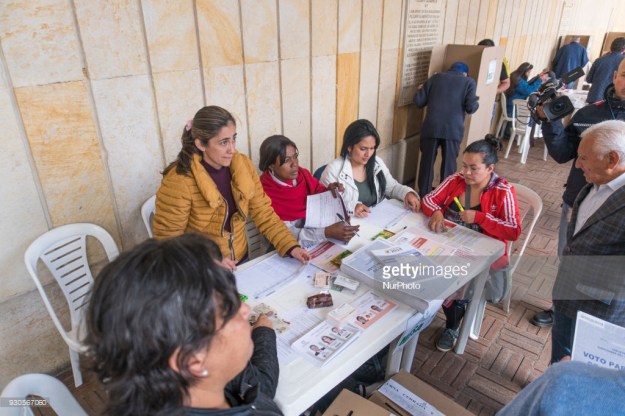
The Colombian people vote at a polling station during Colombian parliamentary elections at Congress of Colombia in Bogota, Colombia on March 11, 2018. (Photo by Daniel Garzon Herazo/NurPhoto)

I’m going to use this perfect indoor time to prepare for my Memorial Day celebration. Not only do I (with some help from a friend) have to prepare the food that will be served, I have to think about the best way to control the political discussions and debates that will inevitably take place. Right now, Colombians in South America and those who can vote in the exterior are heading to the polls to choose a new president. It is election day in Colombia. A few of tomorrow’s guests are Colombians and they are passionate about their national politics, more so, I think, since they are living in the U.S. They will be voting in the exterior at a nearby school. My Memorial Day get-together topics of conversation might be dominated by Colombian politics. I do not need to be reminded that Memorial Day is a celebration of those who have fallen fighting for the right to free speech!

On March 11, 2018, Colombia held general congressional elections and a primary as to which candidates would be run for president. The election was dominated by political rhetorical from all sides. After the voting had concluded, it was obvious that no political party or faction had won sufficient seats in Congress to control the legislative process. Whoever would eventually win the office of the presidency would have to govern by forming alliances to have any legislative success.

Writing months before the primary election Jeronimo Rios Sierra as a guest contributor in Global Americans – Jan 19, 2018 – offered an interesting observation into the average Colombians’ voting mentality. In his article entitled Colombia and the 2018 Presidential Elections, Sierra noted that:

“…it’s noteworthy mentioning that the vast majority use the current pre-election campaign stage to assert interests and support and offer political favors to the highest bidder, given that neither ideology nor party are elements that the voters have very much in consideration when it comes to exercising their vote”

The article offers a first-rate analysis of the issues that are involved in the elections. Yet, from my conversations with my Colombian friends, both here in New York City and in Colombia, there seems to be little discussion about solutions to the country’s problems. The debates invariably center on the personalities of the presidential candidates and their connection to other politicians who once were in power. Colombia’s economic challenges are never discussed.

Economic data suggests that Colombia’s economy is beginning to heat up. Yet, this uptick in the numbers is mostly attributed to rising oil prices. If the country’s economy is to continue improving, the non-oil sector will have to contribute to increased GNP growth.

What today’s presidential candidates could not dispute is Colombia’s failure to meet its 2017 GNP growth goals. The candidates are hard-pressed to say confidently that the country will meet 2018’s projections. President Santos invested a tremendous amount of political capital and money into convincing FARC to lay down its arms and join Colombian society. Even though Colombian refused to approve his referendum for peace, President Santos used his majority in the legislature to get authorization for his peace plan. He argued that his peace plan would triple direct foreign investment into Colombia and boost GNP by 5%. I believe that the Colombian President allowed politics to guide his assessments. The promised economic benefits of the peace agreement have not materialized and probably will not any time soon, if ever.

The Venezuelan refugee crisis will continue to present challenges for Colombia. Venezuelans are fleeing their country in records numbers. The political chaos in Venezuela and the melt-down of the economy is driving residents across the border to safer havens. Colombia, which faces corruption scandals, increased cocaine production and proposed cuts in American aid, has no political or economic solution to the refugee crisis. There is no general consensus in Colombia on how the crisis should be handled. None of today’s candidates have offered a viable political response coupled with financing for their solution to the Venezuelan problem.

At one end of the political spectrum is Gustavo Petro. The leftist candidate promises, if elected, to impose a different economic model on the country. He has campaigned upon a promise of moving the country to a more agricultural base while increasing manufacturing. Land that is underutilized would be distributed to benefit the poor. His progressive tax plan would help reallocate the wealth from the rich to the poor. In typical socialist fashion, Petro offers no concrete proposals for financing his ambitious economic program.

At the other end of the political spectrum is Petro’s principal rival, Ivan Duque. He represents the right and advocates lowering taxes and while promoting big business. Unlike his leftist counterpart, Duque proposes increasing productive, not reducing it. Farming companies and not individual farmers trying to make a living would receive special attention. Duque believes that manufacturing and investing in new technologies would lead to brighter economic days. In my opinion, Colombians have clear choices in terms of the direction of the country. It is curious that economics is not often brought up when people debate the election. I believe that many Colombians’ political stance depends on the personality cult of the candidate. If elected Duque would probably encounter resistance to the enactment of his economic agenda. Clearly, his policies would lead to a reduction of political patronage and a movement of public sectors jobs into the private arena. This is a ¨no.no¨for many Colombians.

In my opinion regardless of the who is elected president the economy will pick up steam in 2018. The only drag on the economy’s forward inertia would be counter-productive policies. In simple terms; the government would have to impede the inevitable rise in oil prices, which will spur growth. The debate Colombians should be having is which candidates’ policies will not impede economic growth. I believe that the election of Petro will lead to a restriction of the economy. If I could vote, which I cannot, he would not receive my vote. Duque would and it as simple as that.

To understand politics in Colombia, you must accept the reality that good jobs are offered by the government. Political patronage at all levels rules the day. These jobs offer stability, some benefits, and a pension. Political supporters are rewarded with these “prime-time” jobs. Consequently, a change in political leadership can and often results in a transfer of jobs to the supporters of the winning party. Unfortunately, as is the case in this election, the policy positions of the candidates are secondary to the abilities to deliver jobs. I have heard heated conversations about the election in terms of family members either having or losing work opportunities.

I am sure that if the conversation at my Memorial Day party turns to the results of the election, no one will civilly discuss how the new government will (should) spur economic growth. Hopefully, the Sangria will not lessen my guest’s inhibitions and help foster outright shouting matches. This evening we will learn the results of today’s election. Depending on the general reaction to the result, I will know how to manage my Colombian guests’ passion for debating the not relevant.