Was it even remotely possible? If we are going to answer this question, we must consider things as they were during that time.
The story…
An inventor who was well-known in scientific circles regularly hosted dinner parties. Not only was the inventor an accomplished mathematician, he was a devoted investigator of molecular physics. Much to his credit, he held a number of patents for some of his inventions.
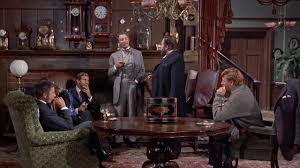
The inventor regularly invited the same group of scholarly gentlemen to house for dinner and conversation. After the group had enjoyed a scrumptious meal, they would retire to an adjoining room for shots of strong liquor,  cigarettes, and in-depth discussions about an esoteric topic, more likely than not, chosen by the host. The guests were invariably treated to the inventor’s passionate lectures on complex topics devote to him. The gentleman, who were all accomplished in their own rights, often thought the inventor to be a bit too caught up with himself and his ideas. By now the men had settled comfortably into their chairs and were waiting for the inventor to start the evening’s conversation. That night the guests could never have imagined the topic that the inventor was about the bring up. The inventor announced that he had discovered how to travel through time and would, in short order, prove it to them.
By now the men had settled comfortably into their chairs and were waiting for the inventor to start the evening’s conversation. That night the guests could never have imagined the topic that the inventor was about the bring up. The inventor announced that he had discovered how to travel through time and would, in short order, prove it to them.
It is not difficult to imagine the response of some of the gentlemen to the inventor’s claim. Preposterous one said. Another asked the inventor if he had lost his mind. Others asked the inventor pointed questions about his time travel theory and the mechanics of traveling about through time. The inventor meticulously addressed his friends’ skepticism by offering an in-depth discussion of the quantum physics of time travel. Afterward, seeing the facials expressions of utter disbelief that surrounded him, the inventor invited his guest to watch, then and there, a live a live demonstration of time travel. They demanded that the experiment begin without delay.
The inventor produced a sphere, “a metallic framework, scarcely larger than a small clock.” He placed the object on a small table and pulled up a chair next to the table. The guests gathered around the inventor and his small time machine. Using the finger of one of the group’s most ardent disbeliever, the inventor flipped a switch and the device began to vibrate. “There was a breath of wind.” The machine grew fainter and fainter to the eye until it disappeared. There was nothing on the table top. Where had it gone?
Immediately, there were cries of fraud. One guest accused the inventor of using “cheap parlor tricks” to make the device disappear. Another expressed his indignation with having his intelligence insulted. Yet, there were a few guests who were intellectually curious and wanted to know how the sphere had disappeared. At this point, the gentlemen were invited to walk with the inventor to his work room. Once inside the room, he introduced them to his almost completed actual size time machine. The inventor announced that he would use the machine to travel through time. He invited the guests to return the following Thursday evening for dinner as usual. At that time, he would give them a report of his adventure with the time machine.
H.G. Wells…
The interaction between the inventor and his guests and the revealing of the time machine is how H. G. Wells began his book the Time Machine, which was published in 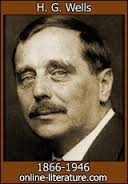 1895. Shortly after introducing the protagonist, Wells refers to him as the “Time Traveler.” None of the guests are ever referred to by their names. They are simply designated by their professions. Most literary experts believe that Wells, along with Jules Verne, was one the fathers of modern-day science fiction writing. In my opinion, this may not be a correct description of Wells as a writer.
To better understand the Time Machine from a literary and political point of view, it is necessary to know how H.G. Wells viewed English society when the book was written.
Wells was born on September 21, 1866. in Bromley England. His parents were hard workers but they never escaped the poverty that engulfed them. When the family’s struggling business finally collapsed, the young Wells worked with his mother. While working there, Wells discovered the owner’s extensive library collection. It seemed like he had found his calling. Wells dedicated hours to reading the owner’s books. He became an voracious reader and developed the ability to self-teach himself almost any subject. The major figures of the Enlightenment attracted his literary curiosity. H.G. Wells’ intellectual
H.G. Wells’ intellectual prowess did not go unnoticed. He received a scholarship to the prestigious Normal School of Science. There he studied physics, chemistry, astronomy, and biology. He also studied all the classical Greek philosophers, including but not limited to Plato and Aristotle.
During his tenure at the Normal School of Science Wells developed his passion for writing. In later years, he would go on to become a prolific writer science fiction and other related genres.
In his first year at the school, Wells studied under Thomas H. Huxley, the English champion of Darwin’s principals of natural selection. The esteemed and well-respected professor impressed upon Wells the idea that natural selection might help explain the dynamics of a society. Wells integrated Darwinism into developing his view of the ideal society.
In my opinion, H.G. Wells was more than qualified, from an intellectual point of view, to discuss the prevalent theories of time travel. Yet, to grasp the true significance of Time Machine , one must know what motivated Wells to write the book.

 paulhunterjones