
Tag Archives: sanctions

Who should pay to rebuild Ukraine?

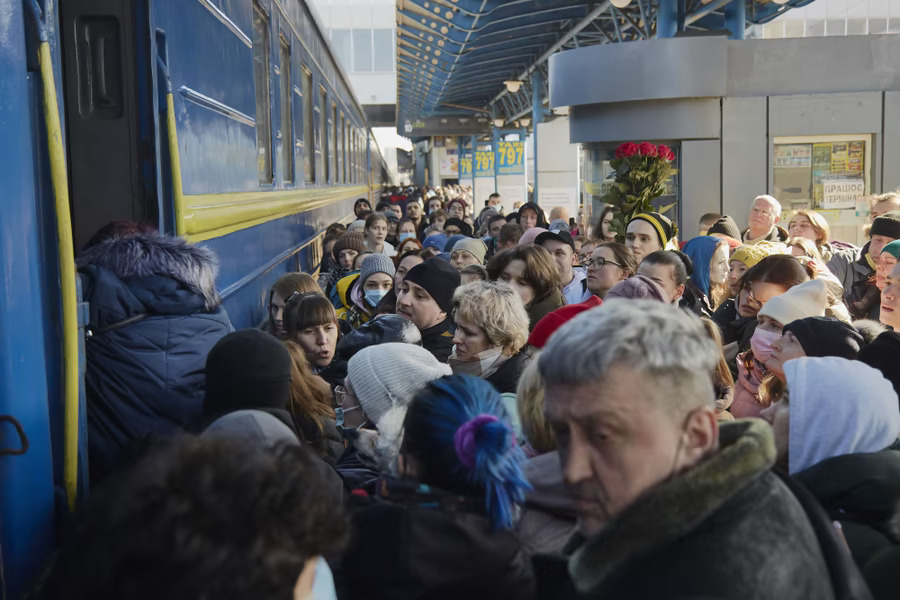
KYIV, UKRAINE – FEBRUARY 26: Local residents are boarding an evacuation train driving to the west of Ukraine on February 26, 2022 in Kyiv, Ukraine. Explosions and gunfire were reported around Kyiv on the second night of Russia’s invasion of Ukraine, which has killed scores and prompted widespread condemnation from US and European leaders. (Photo by Pierre Crom/Getty Images)

The Current Situation

War in Ukraine arrived on March 24, 2022. Russian armored divisions rolled across Ukraine’s borders at several points. For weeks the Russian military had augmented its over-the-border staging areas. When the order was given, Russian troops poured into Ukraine in masse. At first, Russian troops easily pushed deep into Ukraine, or so it seemed. It soon became evident that the vaunted Russian army was suffering from terrible logistics, low troop morale, and a failure to appreciate the tenacity of the Ukrainians as fighters. Russian armored columns literally run out of petrol.

On top of these self-inflicted problems, NATO countries rushed to send sophisticated weapons to the Ukrainians. From what has been reported, Ukrainian soldiers are skillfully using these weapons to hold their own against the Russians. Recently, the fighting seems to have reached a stalemate. Security experts and intelligence officers believe that neither side is gaining or relinquishing territory. The fact that Russia has now engaged in siege warfare points to the fact that a battle stalemate exists.

There is considerable debate over who benefits most from a stalemate, the Russians, or Ukrainians. One thing is for sure; Ukraine’s infrastructure is being systematically destroyed. Russia’s targeting of civilians is creating a refugee problem not seen since the Second World War. Once beautiful and vibrant cities are being reduced to rubble. Who has not seen the destruction and death broadcast daily on the news and in social media posts? Is Russia trying to exterminate the citizens of Ukraine?

Some Historical Perspective

Do you remember the collapse of the USSR? A powerful faction of the communist party officials removed then-President  Mikhail Gorbachev from office. The year was 1991. Gorbachev had favored policies to decentralize the government, bring about economic reforms and improve relations with the West. The old Russian guard sought desperately to reverse perestroika. On August 22, 1991, tanks descended on Red Square to stage a coup. Newly installed President Boris Yeltsin stood on a balcony to personally survey the situation. He gave the peace sign. The coup fizzled out and the breakup of the USSR become official on December 25, 1991.

Ukraine, a USSR satellite state, broke away from the Soviet Union to become an independent and sovereign state. Thirty years later the Soviet Union is trying to forcefully reintegrate militarily and economically this former member of the U.S.S.R. Perhaps history will repeat itself in several ways. Many people hope so!

The Center of the political storm: Viktor Yanukovych

He was born July 9, 1950, in Ukraine, U.S.S.R. At the time of Victor Yanukovych’s birth, the cold war was heating up. Yanukovych attended the Donetsky Polytechnic Institute. In 2000 he received a law degree from the Ukrainian Academy of Foreign trade. Early in his career, he swore his allegiance to the communist party and the U.S.S.R . Yanukovych rose to the top of local politics in the Dumbar region. He ascended to the pinnacle of Ukrainian politics though he did not speak Ukrainian. It should not come as a surprise that Vladimir Putin always supported Yanukovych’s political ambitions, seeing how their goals coincided.

Without going into details the case can be made that the recent political and economic conflict between Russia and Ukraine centered around Yanukovych. His passage through Ukrainian politics and Russia’s inability to subjugate its foreign satellite state led to current “Special Military Action.”  The annexation of the Crimea and attempted subjunction of the Donbas region appear to be Russia’s reaction to Yanukovych’s change of political fortunes.

Yanukovych won in the presidential election in 2010. In-country international poll observers concluded the election had been fair and transparent. The Eastern part of the country voted for Yanukovych. His opponent and sitting president, Victor Yushchenko, received the vote from the Western part of the country. Yuschenko’s supporters took to the streets to protest the election results. Yanukovych suppressed the protests but never really had the support of all Ukrainians. He was ousted from office four years later when he refused to establish closer economic and cultural relations with the West. Instead, he chose to move Ukraine further into Russia’s sphere of influence. Ukraine’s love-hate relationship with Russia cannot be disputed. The two countries are connected by so many factors that an amicable divorce doesn’t seem possible.

On January 25, 2019, a Ukrainian court sitting in Kyiv’s Obolon District sentenced former President Yanukovych to thirteen years in jail. The order of incarceration came almost five years after a popular uprising ousted him from power. He had been charged criminally with having committed several serious crimes. The court convicted and sentenced him upon being found guilty of “crimes against the foundation of Ukraine’s national sovereignty. In simple legal terms, the court convicted him of “high treason.” When he arrived in Moscow, he pleaded with Putin to send into Ukraine Russian troops to restore him to power.  Yanukovych argued that he could resurrect Russia’s influence in Ukraine’s political affairs. According to him, Ukraine could still become a de fact satellite state of Russia.  I believe that Russia began to seriously plan an invasion of Ukraine after the court issued its order of incarceration.

PSU’s Unjust Punishment

On November 5, 2011 Jerry Sandusky, a former Pennsylvania State University (PSU) defensive coordinator for the football team, was arrested. The Pennsylvania State Attorney’s Office was charging him with 40 criminal counts of sexually abusing young boys. The crimes were alleged to have been committed over an extended period. Also arrested were PSU athletic director, Tim Curly and Gary Schultz, the school’s vice president for finance and business. Both men were charged with perjury and failing to report what they knew about the allegations. PSU’s legendary coach, Joe Paterno, was not charged with any crime. Coincidentally the PSU football was not in action that weekend so the campus was rather subdued.

The arrests put the football program under the public microscope for its moral values and social responsibility to the community. The commentators and pundits immediately began discussing how the culture of big time collegiate sports created an atmosphere at PSU that allowed Mr. Sandusky to abuse children at will. It was suggested that the University was more concerned about bad publicity and not protecting young children from a known pedophile. How PSU and its vaunted football program would come out of mess was and always has been the question on everyone’s mind.

Sandusky had his proverbial day in court to contest the charges. The trial judge refused to allow the live broadcasting of any of the proceedings. During the breaks in the trial and at the conclusion of the daily proceedings summaries and updates became available from the reporters who were inside the courtroom. Their reports only galvanized the view that something was seriously wrong at PSU. The victims, some now adults, testified in graphic and horrific terms how Mr. Sandusky had repeatedly sexually abused them. The State Attorneys presented an overwhelming case against Sandusky. Some of the abuse took place on PSU property, in particular, facilities used by the football team. It was no surprise to anyone that Sandusky declined to testify in his own behalf. The jury took less than 20 hours to convict Sandusky of 45 of the 48 counts of the indictment. Sandusky has yet to be sentence but it is believed that he will spend the rest of his life in jail.

The conviction served as fresh ammunition for those who believed that the PSU had lost intuitional control of its football program. Worst yet were the accusations that the institution simply refused to challenge Joe Paterno’s running of the football program. The Board of Trustees at PSU realized that the Sandusky scandal required that the university thoroughly investigate the entire affair. The investigation had to be professionally undertaken, comprehensive and transparent to prevent any claim of a cover-up.

In order to guide the University through the maze of legal and moral problems it was facing the Board of Trustees commissioned former federal judge and FBI director Louie Freeh and his law firm to investigate and report on the Sandusky scandal. Judge Freeh took 8 months to complete his report. His office interviewed countless witnesses and reviewed more than a million e-mails. The 250+ page written report was long enough to be thorough and short enough not to be weighed down by detail. The entire report is available online.

Once the report was made public the Board of Trustees realized that Freeh’s work, which they had commissioned, constituted an indictment of the University’s football program and PSU as an institution of higher education. According to the Freeh report PSU football had become a de facto entity unto itself. It seemed to operated separately and beyond PSU’s institutional grip. The written report damaged the prestige and reputation of PSU. Yet it was Judge Freeh’s very public press conference that shattered any hope that PSU had of salvaging something from the scandal.  At his press conference Judge Freeh clearly laid out, in terms that everyone could comprehend, the case that Penn State officials participated in a cover-up of Sandusky’s pedophilic tendencies. In particular Judge Freeh stated the following:

“The evidence shows that these four men also knew about a 1998 criminal investigation of Sandusky relating to suspected sexual misconduct with a young boy in a Penn State football locker room shower.  Again, they showed no concern about that victim.  The evidence shows that Mr. Paterno was made aware of the 1998  investigation of Sandusky, followed it closely, but failed to take any action, even though Sandusky had been a key member of his coaching staff for almost 30 years, and had an office just steps away from Mr. Paterno’s.  At the very least, Mr. Paterno could have alerted the entire football staff, in order to prevent Sandusky from bringing another child into the Lasch Building.  Messrs. Spanier, Schultz, Paterno and Curley also failed to alert the Board of Trustees about the 1998 investigation or take any further action against Mr. Sandusky.  None of them even spoke to Sandusky about his conduct.  In short, nothing was done and Sandusky was allowed to continue with impunity” pg. 5 of the press release

In my opinion the Board of Trustees should have received the Freeh report in confidence. The Board then could have deliberated behind closed doors on its use. Clearly Judge Freeh would not have held the press conference if the Board had not granted him their approval to do so. It seems to me that the Board might have over reacted to public pressure and its claim of a cover-up.